





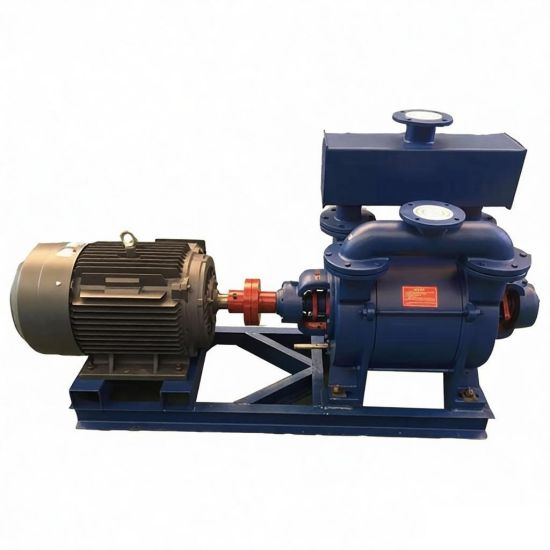
China Factory Industrial Vacuum Pumps: 2BV, 2BEA, SK, 2SK, 2X, 2XZ, XD, ZJ and LG Engineering Selection Guide
This article is designed as an Industrial Vacuum Pump Knowledge Center for engineers, EPC contractors, maintenance departments, industrial buyers and OEM equipment manufacturers. The main subject is vacuum technology; electric motors are treated only as auxiliary drive equipment where relevant.
1. Why Does Industrial Vacuum Pump Selection Start With Absolute Pressure?
Vacuum equipment operates below atmospheric pressure. For engineering calculations, the most useful reference is absolute pressure rather than only the vacuum gauge reading.
At standard atmospheric pressure of approximately 101325 Pa, a gauge reading close to −0.098 MPa corresponds to an absolute pressure of approximately 3300 Pa. This provides a useful preliminary boundary when deciding whether a water ring vacuum pump or a deeper-vacuum technology should be investigated.
2. Industrial Problems and Vacuum Pump Solutions
Problem: High Water Vapor Load
Drying, evaporation and filtration systems may contain substantial water vapor. Water ring vacuum pumps such as the 2BV and 2BEA families can be considered where the process pressure is compatible with their operating range.
Problem: High Pumping Speed
Large vacuum chambers and continuous industrial systems require high pumping capacity. Large water ring pumps or ZJ Roots booster systems can be evaluated according to the actual operating pressure.
Problem: Deep Vacuum
When the required absolute pressure is significantly lower, two-stage rotary vane pumps, Roots booster systems or dry screw technologies may be considered.
Problem: Dust and Particles
Dust can damage vacuum equipment. Filtration, separators and correct inlet protection should be designed before the vacuum pump.
Problem: Oil-Free Processing
Chemical, pharmaceutical and sensitive production processes may require oil-free vacuum technology. Dry screw vacuum pumps such as the LG family can be evaluated for these applications.
Problem: Fast Pump-Down
Fast pump-down requires calculation of chamber volume, pressure ratio, pipe conductance and real pumping speed at the target pressure rather than relying only on nominal catalogue capacity.
3. Main Industrial Vacuum Pump Families
2BV Water Ring Vacuum Pump
Compact water ring vacuum pump family for industrial vacuum applications, especially where water vapor handling and simple operation are important.
Models: 2BV-2061, 2BV-5110, 2BV-5111, 2BV-5131, 2BV-5161.
2BEA Water Ring Vacuum Pump
Large industrial water ring vacuum pump family for high-capacity vacuum systems.
Models: 2BEA-202, 2BEA-203, 2BEA-252, 2BEA-253, 2BEA-303, 2BEA-353.
SK Water Ring Vacuum Pump
Economical water ring vacuum pump family for industrial rough vacuum applications.
Models: SK-1.5, SK-3, SK-6, SK-20, SK-30.
2SK Two-Stage Water Ring Pump
Two-stage water ring configuration for applications requiring a stable vacuum within the applicable operating range.
Models: 2SK-1.5, 2SK-3, 2SK-6, 2SK-20.
2X Rotary Vane Vacuum Pump
Two-stage rotary vane technology for applications requiring deeper vacuum than typical water ring systems.
Models: 2X-2, 2X-4, 2X-8, 2X-15.
2XZ Direct-Drive Vacuum Pump
Compact direct-drive rotary vane vacuum pumps for laboratory and small industrial systems.
Models: 2XZ-2, 2XZ-4.
XD Rotary Vane Vacuum Pump
Rotary vane vacuum pump family used for packaging, plastics, printing and centralized vacuum applications.
Models: XD-020, XD-040, XD-100.
ZJ Roots Vacuum Pump
Roots vacuum booster technology used together with an appropriate backing pump to increase pumping speed.
Models: ZJ-300, ZJ-600, ZJ-1200 and other sizes.
LG Dry Screw Vacuum Pump
Dry screw vacuum technology for applications where oil-free operation and process cleanliness are important.
Model example: LG-50.
4. Industrial Vacuum Pump Technical Parameter Comparison
| Series | Example Models | Technology | Typical Capacity Range | Vacuum Application | Typical Industries |
|---|---|---|---|---|---|
| 2BV | 2BV-2061, 2BV-5110, 2BV-5111, 2BV-5131, 2BV-5161 | Water ring | Approx. 27–500 m³/h depending on model | Rough / medium vacuum | Drying, filtration, chemical processing |
| 2BEA | 2BEA-202, 2BEA-203, 2BEA-252, 2BEA-253, 2BEA-303, 2BEA-353 | Large water ring | Large industrial capacity | Industrial vacuum systems | Power, metallurgy, mining, chemical |
| SK | SK-1.5, SK-3, SK-6, SK-20, SK-30 | Water ring | Approx. 1.5–30 m³/min for listed sizes | Rough vacuum | Filtration, drying, packaging |
| 2SK | 2SK-1.5, 2SK-3, 2SK-6, 2SK-20 | Two-stage water ring | Approx. 1.5–20 m³/min for listed sizes | Lower pressure range | Industrial process vacuum |
| 2X | 2X-2, 2X-4, 2X-8, 2X-15 | Two-stage rotary vane | 2–15 L/s for listed models | Deeper vacuum | Vacuum coating, heat treatment |
| 2XZ | 2XZ-2, 2XZ-4 | Direct-drive rotary vane | 2–4 L/s for listed models | Deep vacuum | Laboratory and compact equipment |
| XD | XD-020, XD-040, XD-100 | Rotary vane | Approx. 20–100 m³/h | Industrial vacuum | Packaging, plastics, printing |
| ZJ | ZJ-300, ZJ-600, ZJ-1200 | Roots booster | Approx. 300–1200 L/s | Booster vacuum system | Metallurgy, large vacuum systems |
| LG | LG-50 | Dry screw | Approx. 50 L/s example | Oil-free vacuum | Chemical, pharmaceutical, clean processing |
The values above are engineering reference values rather than a substitute for the current manufacturer data sheet. Final selection should use the actual pump performance curve at the required operating pressure.
5. How to Calculate Required Pumping Speed
For a preliminary closed-chamber pump-down calculation, the required pumping speed can be estimated using:
Where S is the theoretical pumping speed, V is chamber volume, t is pump-down time, P₁ is initial absolute pressure and P₂ is target absolute pressure.
Engineering Example
For a 1000 L chamber that must be evacuated from 101325 Pa to 5000 Pa within 60 seconds:
The actual selection must then consider pipe conductance, valves, leakage, gas load and pump performance at the target pressure. A nominal 180 m³/h pump does not necessarily deliver 180 m³/h effective pumping speed at the chamber.
6. 30 Engineering Application Cases With Specific Vacuum Pump Models
The following cases are structured as engineering application references. They demonstrate how specific vacuum pump models can be matched with typical industrial equipment. They should not be interpreted as named customer projects unless the project is independently documented and verified.
01. Vacuum Filtration — 2BV-5111
- Industry: Chemical processing
- Equipment: Vacuum filter
- Pump model: 2BV-5111
- Reference capacity: approximately 230 m³/h
- Engineering objective: Maintain stable filtration vacuum and handle moisture-containing gas.
02. Industrial Drying — 2BV-5110
- Industry: Food processing
- Equipment: Vacuum drying chamber
- Pump model: 2BV-5110
- Reference capacity: approximately 165 m³/h
- Engineering objective: Remove air and water vapor during drying.
03. Vacuum Dehydration — 2BV-5131
- Industry: Materials processing
- Equipment: Vacuum dehydration system
- Pump model: 2BV-5131
- Reference capacity: approximately 400 m³/h
- Engineering objective: Increase vacuum capacity for continuous dehydration.
04. Process Degassing — 2BV-5161
- Industry: Chemical industry
- Equipment: Degassing vessel
- Pump model: 2BV-5161
- Reference capacity: approximately 500 m³/h
- Engineering objective: Remove air and condensable vapors from process material.
05. Mineral Vacuum Filtration — 2BEA-253
- Industry: Mining
- Equipment: Large vacuum filter
- Pump model: 2BEA-253
- Technology: Large water ring vacuum pump
- Engineering objective: Continuous vacuum filtration of mineral slurry.
06. Power Plant Condenser Vacuum — 2BEA-303
- Industry: Power generation
- Equipment: Steam turbine condenser auxiliary vacuum system
- Pump model: 2BEA-303
- Technology: Water ring
- Engineering objective: Remove non-condensable gases from the condenser system.
07. Large Power Vacuum Station — 2BEA-353
- Industry: Power engineering
- Equipment: Central vacuum station
- Pump model: 2BEA-353
- Technology: Large water ring
- Engineering objective: High-capacity industrial vacuum generation.
08. Vacuum Packaging — SK-3
- Industry: Food packaging
- Equipment: Vacuum packaging line
- Pump model: SK-3
- Reference capacity: approximately 3 m³/min
- Engineering objective: Rapid removal of air from packages.
09. Vacuum Drying — SK-6
- Industry: Food and materials processing
- Equipment: Vacuum dryer
- Pump model: SK-6
- Reference capacity: approximately 6 m³/min
- Engineering objective: Moisture removal under controlled vacuum.
10. Paper Machine Vacuum — SK-20
- Industry: Pulp and paper
- Equipment: Paper machine vacuum system
- Pump model: SK-20
- Reference capacity: approximately 20 m³/min
- Engineering objective: Continuous process vacuum.
11. Continuous Filtration — SK-30
- Industry: Chemical processing
- Equipment: Continuous vacuum filter
- Pump model: SK-30
- Reference capacity: approximately 30 m³/min
- Engineering objective: Stable large-flow vacuum extraction.
12. Vacuum Drying Chamber — 2SK-1.5
- Industry: Industrial materials
- Equipment: Vacuum drying chamber
- Pump model: 2SK-1.5
- Reference motor power: approximately 4 kW
- Engineering objective: Stable two-stage water ring vacuum.
13. Vacuum Forming — 2SK-3
- Industry: Plastics
- Equipment: Vacuum forming machine
- Pump model: 2SK-3
- Reference motor power: approximately 7.5 kW
- Engineering objective: Generate process vacuum for forming.
14. Mineral Slurry Filtration — 2SK-6
- Industry: Mining
- Equipment: Vacuum filter
- Pump model: 2SK-6
- Reference motor power: approximately 15 kW
- Engineering objective: Vacuum-assisted dewatering.
15. Cement Plant Vacuum — 2SK-20
- Industry: Cement manufacturing
- Equipment: Process vacuum system
- Pump model: 2SK-20
- Reference motor power: approximately 45 kW
- Engineering objective: Industrial vacuum generation.
16. Vacuum Coating — 2X-2
- Industry: Electronics and surface treatment
- Equipment: Vacuum coating chamber
- Pump model: 2X-2
- Technology: Two-stage rotary vane
- Engineering objective: Preliminary deep-vacuum evacuation.
17. Vacuum Heat Treatment — 2X-4
- Industry: Mechanical engineering
- Equipment: Vacuum heat-treatment furnace
- Pump model: 2X-4
- Technology: Two-stage rotary vane
- Engineering objective: Furnace evacuation before controlled heating.
18. Laboratory Vacuum System — 2X-8
- Industry: Research and development
- Equipment: Laboratory vacuum chamber
- Pump model: 2X-8
- Technology: Two-stage rotary vane
- Engineering objective: Deeper vacuum for experimental processes.
19. Industrial Vacuum Equipment — 2X-15
- Industry: Industrial manufacturing
- Equipment: Medium-size vacuum chamber
- Pump model: 2X-15
- Technology: Two-stage rotary vane
- Engineering objective: High-capacity deep-vacuum evacuation.
20. Laboratory Drying — 2XZ-2
- Industry: Laboratory processing
- Equipment: Small vacuum drying chamber
- Pump model: 2XZ-2
- Technology: Direct-drive rotary vane
- Engineering objective: Compact vacuum generation.
21. Transformer Component Drying — 2XZ-4
- Industry: Electrical equipment manufacturing
- Equipment: Vacuum drying system
- Pump model: 2XZ-4
- Technology: Direct-drive rotary vane
- Engineering objective: Moisture removal from components.
22. Vacuum Packaging — XD-020
- Industry: Food and consumer products
- Equipment: Packaging machine
- Pump model: XD-020
- Reference capacity: approximately 20 m³/h
- Engineering objective: Fast package evacuation.
23. Plastic Extrusion — XD-040
- Industry: Plastics
- Equipment: Extrusion line
- Pump model: XD-040
- Reference capacity: approximately 40 m³/h
- Engineering objective: Remove air and volatile components from the process.
24. Printing Vacuum System — XD-100
- Industry: Printing
- Equipment: Industrial printing line
- Pump model: XD-100
- Reference capacity: approximately 100 m³/h
- Engineering objective: Stable vacuum supply for production equipment.
25. Metallurgical Vacuum Booster — ZJ-300
- Industry: Metallurgy
- Equipment: Vacuum processing system
- Pump model: ZJ-300
- Reference pumping speed: approximately 300 L/s
- Engineering objective: Increase pumping speed with a Roots booster.
26. Vacuum Degassing System — ZJ-600
- Industry: Metallurgy
- Equipment: Vacuum degassing system
- Pump model: ZJ-600
- Reference pumping speed: approximately 600 L/s
- Engineering objective: High-speed evacuation in the applicable pressure range.
27. Large Vacuum System — ZJ-1200
- Industry: Heavy industry
- Equipment: Large vacuum chamber
- Pump model: ZJ-1200
- Reference pumping speed: approximately 1200 L/s
- Engineering objective: High-throughput booster vacuum.
28. Dry Chemical Vacuum — LG-50
- Industry: Chemical processing
- Equipment: Dry process vacuum system
- Pump model: LG-50
- Reference pumping speed: approximately 50 L/s example
- Engineering objective: Oil-free vacuum processing.
29. Roots + Water Ring Vacuum System — ZJ-300 + 2BV-5111
- Industry: Industrial vacuum processing
- Equipment: Combined vacuum station
- Booster: ZJ-300
- Backing pump: 2BV-5111
- Engineering objective: Increase pumping speed while using a water ring backing pump.
30. Large Combined Vacuum System — ZJ-600 + 2BEA-253
- Industry: Mining / metallurgy
- Equipment: Large industrial vacuum station
- Booster: ZJ-600
- Backing pump: 2BEA-253
- Engineering objective: Combine Roots boosting with high-capacity water ring vacuum generation.
7. Vacuum Pump Selection: A Procurement Engineer's Checklist
| Parameter | Required Information | Why It Matters |
|---|---|---|
| Chamber volume | L or m³ | Determines theoretical pump-down requirement. |
| Starting pressure | Pa absolute | Defines the initial vacuum condition. |
| Target pressure | Pa absolute | Determines required pump technology. |
| Pump-down time | Seconds or minutes | Determines required effective pumping speed. |
| Gas composition | Air, steam, solvent, corrosive gas, etc. | Determines material and pump technology. |
| Water vapor | Mass flow / temperature | Important for water ring and oil-sealed systems. |
| Dust | Particle concentration | Determines filtration and separator requirements. |
| Temperature | °C | Affects condensation and pump performance. |
| Operating cycle | Continuous / intermittent | Determines thermal and mechanical design requirements. |
| Pipeline | Diameter / length / valves | Determines conductance and actual chamber pumping speed. |
8. Industrial Vacuum Pump Knowledge Center
How do I choose between 2BV and 2BEA?
The decision should be based on required pumping speed, working pressure, gas load and installation requirements. 2BV is commonly investigated for compact systems, while 2BEA is intended for larger industrial vacuum capacities.
When should I consider SK or 2SK?
SK can be considered for conventional water ring vacuum applications. Two-stage 2SK configurations may be investigated when the process requires a different pressure range or more stable vacuum performance.
When should a ZJ Roots booster be added?
A ZJ booster can be added when the existing backing pump cannot provide sufficient pumping speed in the required pressure range. The Roots pump must be matched with a suitable backing pump and operating pressure.
What is the difference between nominal pumping speed and effective pumping speed?
Nominal pumping speed is normally stated at a specified test condition. Effective pumping speed at the chamber is lower when pipe conductance, valves, filters, elbows and other restrictions are included.
Why does water temperature matter for water ring pumps?
Water ring pump performance depends on the thermodynamic condition of the sealing liquid. Higher liquid temperature can influence vapor pressure and therefore the attainable vacuum.
9. Problem-Based Industrial SEO Questions
What vacuum pump should I use for vacuum drying?
Evaluate water vapor load first. Water ring pumps such as 2BV, 2SK and SK can be investigated for suitable pressure ranges. For deeper vacuum requirements, rotary vane or dry vacuum technology may be more appropriate.
What vacuum pump is suitable for mining filtration?
Large continuous vacuum filtration often requires high pumping capacity. Models such as 2BEA-253 should be evaluated against the filter area, gas load and actual working pressure.
Which vacuum pump is suitable for plastic extrusion?
Rotary vane models such as XD-040 can be considered for suitable extrusion applications, with proper protection against condensable vapors and process contamination.
How do I select a vacuum pump for a cement plant?
The selection should consider dust, continuous duty, required pressure and filtration. Water ring pumps can be evaluated when the process conditions are compatible.
How do I build a Roots vacuum system?
Select the required operating pressure and pumping speed first, then match a ZJ booster with an appropriately sized backing pump such as a water ring, rotary vane or dry screw pump.
Which vacuum pump is suitable for oil-free processing?
Dry screw vacuum technology such as the LG family can be investigated when minimizing oil contamination is a critical process requirement.
10. Industrial Motor Knowledge Center — Auxiliary Drive Engineering
Industrial vacuum pumps are often driven by electric motors. However, motor selection is a supporting engineering task rather than the primary subject of this vacuum pump knowledge page.
For complete motor engineering information, Sealocean Group can separately provide technical information covering YKK, YKS, YRKK, YRKS, YB, YBX, YBX3, YBX4, YBX5, YE3, YE4, Z, Z4 and ZZJ motor families.
| Motor Knowledge Topic | Engineering Focus |
|---|---|
| YKK / YKS | High-voltage industrial motor cooling, enclosure and large-drive applications. |
| YRKK / YRKS | Wound-rotor motor applications and high-starting-torque industrial drives. |
| YB / YBX Series | Explosion-protected motor selection for hazardous industrial environments. |
| YE3 / YE4 | Energy-efficient low-voltage motor applications. |
| Z / Z4 / ZZJ | Industrial DC motor applications and controlled-speed drives. |
11. Industrial Standards and Engineering Compliance
Industrial vacuum systems should be specified according to the applicable equipment standards, electrical requirements, pressure conditions, materials and site regulations. The correct compliance route depends on the equipment type and destination market.
- ISO-based quality management requirements for manufacturing systems.
- IEC requirements for associated electrical equipment where applicable.
- Local electrical and machinery regulations.
- Explosion-protection requirements where hazardous gases are present.
- Material compatibility requirements for corrosive process gases.
- Customer EPC specifications and plant engineering standards.
12. Vacuum Pump Maintenance Engineering
- Check bearing and shaft operating condition according to the pump design.
- Monitor water temperature and water quality on water ring systems.
- Inspect separators and filters regularly.
- Prevent excessive solids from entering the vacuum pump.
- Check air leakage at flanges, valves and flexible connections.
- Monitor unusual vibration and noise.
- Check oil condition for rotary vane pumps.
- Use appropriate gas ballast procedures where applicable.
- Confirm cooling conditions for continuous operation.
- Record operating pressure and pumping performance for preventive maintenance.
13. Vacuum Pump Images and Factory Documentation


Use the actual original product and factory images from the existing Sealocean Group website in these image positions. Every image should have a unique descriptive ALT, title and caption based on the real photograph.
14. Industrial Vacuum Pump Video
More technical videos and factory information are available through the official Sealocean Group YouTube channel.
15. FAQ for Industrial Vacuum Pump Procurement
Provide chamber volume, starting pressure, target absolute pressure, pump-down time, gas composition, vapor load, temperature, dust concentration and operating cycle. These parameters allow the engineering team to identify a suitable pump family and size.
2BV-5111 can be considered for suitable vacuum drying systems, particularly where water vapor handling and the required pressure are compatible with water ring technology. Final selection must be checked against the actual gas load.
2BEA-253 can be considered for high-capacity industrial vacuum applications such as large filtration systems and other processes requiring substantial water ring pumping capacity.
A ZJ-300 and 2BV-5111 can form a Roots-plus-water-ring configuration when the pressure range, conductance and gas load are suitable. The complete system must be engineered rather than selected by model number alone.
Send the chamber volume, target pressure, required pump-down time, gas composition, vapor content, temperature, dust or particles, operating cycle, installation altitude and electrical supply information.
Yes. OEM engineering can be evaluated according to the required vacuum pump model, operating conditions, motor configuration, separator, valves, control system, skid arrangement and destination-market requirements.
No. Performance can vary according to pump construction, rotational speed, sealing liquid temperature, test conditions, motor configuration and other design factors. The final technical offer should use the selected manufacturer's current data sheet.
16. Internal Industrial SEO Knowledge Network
17. Spanish and Portuguese Industrial SEO Content
The English page should act as the primary international technical page. Spanish and Portuguese versions should be independently localized rather than mechanically translated, with their own title, meta description, headings, FAQ and search intent.
| Language | Primary Search Intent | Recommended Content Focus |
|---|---|---|
| English | Industrial vacuum pump engineering | Global B2B procurement, OEM, EPC and technical selection |
| Spanish | Bomba de vacío industrial | Latin America, Spain, mining, chemical and food industries |
| Portuguese | Bomba de vácuo industrial | Brazil, Latin America, mining, steel, cement and process industries |
| Russian | Промышленный вакуумный насос | Russia, CIS, Eastern Europe and industrial engineering procurement |
18. Sealocean Group as an Industrial Engineering Authority
Sealocean Group positions this knowledge center around engineering experience, manufacturing capability, technical selection and international industrial procurement rather than simple product promotion.
The objective is to connect industrial problems with measurable technical requirements and then match the requirements to specific vacuum pump models, system configurations and engineering solutions.
19. Official Sealocean Group Channels
Request an Industrial Vacuum Pump Engineering Solution
Send the chamber volume, target absolute pressure, required pump-down time, gas composition and vapor load. Sealocean Group can evaluate the appropriate vacuum pump family, specific model and system configuration.
Email:
[email protected]
[email protected]
WhatsApp: +86 15985840856


 Chinese
 Deutsch
 Espanol
 Francais
 Italiano
 Portugues
 Japanese
 Korean
 Arabic
 Russian
